
EII Books & Publications for Sale
Institute-published books, standards volumes, and practitioner guides available for purchase in eBook, paperback, and hardcover editions through Amazon and Apple Books.
Browse our catalog
Each title links directly to the retailer for the format you choose. EII members receive member pricing at Institute events; bookstore transactions are completed on the retailer's platform.
 Featured
CCF Body of Knowledge
The Authoritative Knowledge Base for Clinical Cybersecurity, Enterprise Digital Wellness, and Mission Readiness
by Patrick J. Doliny
CCF Volume I introduced a different question for cybersecurity leadership: not simply whether controls exist, audits pass, or incidents are contained, but whether the digital enterprise is healthy enough to fulfill its mission. It introduced cyber wellness, the enterprise organism, the digital immune system, a clinical operating cycle, maturity, resilience planning, vital signs, AI governance, and readiness. The work did not stop with Volume I. As CCF was applied, challenged, expanded, and connected to resilience, AI, executive decision making, recovery, and the emerging discipline of Enterprise Intelligence, several concepts matured. Digital Biomarkers became the proposed atomic units of CCF measurement. Digital Vital Signs became aggregated views of physiological system condition. Wellness Performance Indicators separated health trajectory from project completion. The Cyber Wellness Plan became the treatment portfolio. Mission Readiness became the question of whether wellness is sufficient for purpose. CCF Phoenix clarified that service restoration is not the same as full health after a breach. CCF Genesis extended wellness to the point of enterprise creation. This Body of Knowledge brings those ideas into one controlled architecture. Its role is different from a trade book. A trade book can inspire, explain, and persuade. A body of knowledge must define, distinguish, organize, constrain, and make practice repeatable. It must identify what is canonical, what is guidance, what is illustrative, and what remains a research question.

CCF Phoenix
RETURN TO FULL HEALTH AFTER THE BREACH
by Patrick J. Doliny
A cyber breach creates an understandable urgency to restore service. Leaders want systems online, customers served, payroll processed, and public pressure reduced. That work is essential. It is also incomplete. An enterprise can be operational while identity remains untrusted, data remains uncertain, employees remain exhausted, temporary controls remain embedded, and the conditions that enabled the breach remain largely intact. CCF Phoenix was created for the period after emergency response, when the organization has survived but has not yet returned to full health. It is not an incident response plan, a forensic handbook, or a technical restoration guide. Those disciplines preserve life and contain damage. Phoenix begins with a different question: what must be healed, rebuilt, validated, and strengthened before leadership can truthfully say that the enterprise is healthy again? The mission is not minimum viable business. The mission is sustainable full health. Full health does not mean perfection, zero risk, or a return to the exact pre-breach state. It means the organization can execute its mission within defined tolerances, trust its identities and data, sustain its workforce, recover its critical services, explain its decisions, and demonstrate that treatment produced measurable improvement. The central promise of this book is simple: recovery gets you back online; Phoenix gets you back to full health.

CCF Genesis™
Wellness by Design™
by Patrick J. Doliny
START HEALTHY BEFORE YOU NEED TO HEAL Most cybersecurity begins too late. A product has already been designed. Accounts have already been created. Customer data is already flowing. Vendors are already connected. Artificial intelligence is already being used. The organization is already depending on systems no one has fully mapped. Then someone asks, “How do we secure all of this?” CCF Genesis begins earlier. It starts when the enterprise is still an idea, when the founder can make small decisions that prevent large problems. It asks a simple question: What will this organization need in order to remain healthy when it succeeds? The mature Clinical Cybersecurity Framework asks how healthy the digital enterprise is. CCF Genesis asks whether we are creating an enterprise capable of becoming and remaining healthy. That difference matters. It is easier to build trust into a product than to recover it after a breach. It is easier to define ownership before the team grows than to untangle access later. It is easier to decide what must always work before customers depend on it than during an outage.
 Featured
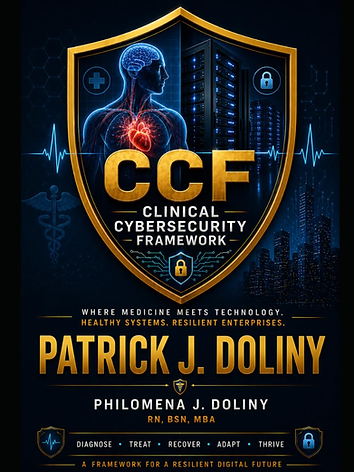
Clinical Cybersecurity Framework Volume I
Foundations of Clinical Cybersecurity
by Patrick J. Doliny & Philomena J. Doliny, RN, BSN, MBA
The inaugural volume of the Clinical Cybersecurity Framework (CCF) series, establishing the foundational domains, digital biomarkers, and maturity model for clinical cybersecurity in the enterprise.