An independent professional institution for a new discipline
The Enterprise Intelligence Institute exists to establish, validate, standardize, advance, teach, credential and continuously evolve Enterprise Intelligence as a professional discipline.
Stewardship of a profession
The Institute's mission is to advance the science and practice of Enterprise Intelligence — connecting knowledge, research, standards, education, professional practice, community and enterprise impact into a single institutional flywheel.
The vision is a recognized profession: a shared body of knowledge, governed standards, credible credentials, an active research base, and a global community of practitioners serving the Mission Readiness of the enterprises they serve.
"The Enterprise Intelligence Institute exists to establish, validate, standardize, advance, teach, credential and continuously evolve Enterprise Intelligence as a professional discipline."
A profession before it had a name
For decades, the disciplines that shape the digital enterprise have matured in parallel — security, AI, data, identity, resilience, governance. Their effects on the enterprise are deeply interconnected, yet no profession existed to understand that interconnection. EII was founded to give that work a name, a home, and a standard of practice.
Establishing the Institute and the Profession
The Founding Declaration (IEI-001) is the Institute's foundational document — the act of establishment that names the discipline, states its purpose, and commits the Institute to the principles of independence, evidence, and distinction. It will be signed at the Founding Assembly on September 18, 2026.
Independence
The Institute's standards and research will not be for sale to sponsors, members, or partners.
Evidence
No construct is presented as validated until it has been.
Distinction
The Institute, the CCF, dōlogiic, and academic partners remain separate and clearly bounded entities.
The full text of the Founding Declaration will be published as an institutional historical record following the Assembly.
Entity purpose, governing bodies, and affiliate boundaries
The Institute Charter (IEI-002) defines the entity's purpose, the structure of its governing bodies, and the boundaries between the Institute and its affiliated organizations. The Institute is formally established as a federally recognized 501(c)(3) tax-exempt organization with adopted governing documents; the summary below is a public-facing overview of that charter.
The Enterprise Intelligence Institute is incorporated as a nonprofit corporation and has been recognized by the Internal Revenue Service as a tax-exempt organization under Section 501(c)(3) of the Internal Revenue Code. The Institute has been issued an Employer Identification Number (EIN) by the IRS. The full governing documents — charter, bylaws, and policies — are maintained on file and available upon appropriate request in accordance with IRS disclosure requirements for tax-exempt organizations.
1. Name and Purpose
The working name of the entity is the Institute for Enterprise Intelligence ("the Institute"), pending trademark and name-availability clearance.
"The Institute is established to advance the science, standards, education, research, and professional practice of Enterprise Intelligence — the discipline concerned with understanding, measuring, and improving the health, resilience, and mission readiness of the modern enterprise as a connected, digital system."
This purpose statement is drawn from the Founding Declaration (IEI-001) and should remain consistent with it.
2. Entity Type and Tax Status
The Institute is organized as a nonprofit corporation and has been recognized by the Internal Revenue Service as a tax-exempt organization under Section 501(c)(3) of the Internal Revenue Code. The IRS has issued the Institute an Employer Identification Number (EIN).
501(c)(3) — Educational and Scientific Organization
The Institute is recognized as a tax-exempt charitable, educational, and scientific organization under Section 501(c)(3). Contributions to the Institute may be tax-deductible as charitable contributions under federal income tax law. Donors should consult their tax advisors regarding deductibility.
The Institute's IRS determination letter, EIN, and related filings are maintained on file and available upon appropriate request in accordance with IRS disclosure requirements applicable to tax-exempt organizations.
3. Governing Bodies
| Body | Authority | Governing Document |
|---|---|---|
Board of Directors | Legal and fiduciary authority over the entity | Bylaws (IEI-003 companion) — adopted |
Founding Council | Advises on and shapes the direction of the profession and standards; not a fiduciary body | IEI-004 Founding Council Charter |
Founding Fellows | Contribute expertise and work product to standards, research, and education | IEI-005 Founding Fellow Standard |
General Membership | Participates per membership class; voting rights defined in the adopted bylaws | IEI-006 Membership Framework |
4. Relationship to Affiliated Entities
The Charter states plainly the boundaries between the Institute and its affiliated organizations. This is the most consequential section in the Charter — it must not be finalized without IP counsel confirming that adopting it does not unintentionally transfer, dilute, or create an implied license to the CCF, Digital Biomarker, or Cortex intellectual property.
The Institute is an independent entity. It does not own, and is not owned by, dōlogiic or the CCF Institute.
The Clinical Cybersecurity Framework (CCF) and its intellectual property remain the property of their existing owner(s) unless and until a separate, counsel-reviewed licensing agreement transfers or licenses specific rights to the Institute.
dōlogiic's commercial products (including the Enterprise Digital Cortex) operationalize the methodology commercially; the Institute does not endorse dōlogiic's products as a condition of standards participation, and dōlogiic does not receive standards influence by virtue of the relationship.
FMU and other academic partners relate to the Institute through separate partnership agreements, not through governance authority over the Institute itself.
5. Amendment Process
The process, quorum, and vote threshold required to amend this Charter are defined in the Institute's adopted bylaws, consistent with the entity's 501(c)(3) status and state of incorporation. A common structure is Board approval plus a defined supermajority of voting members.
6. Dissolution
The Institute's governing documents include a dissolution clause consistent with the requirements of Section 501(c)(3), specifying that remaining assets are distributed for one or more exempt purposes within the meaning of Section 501(c)(3) of the Internal Revenue Code.
Independent and vendor neutral
EII is an independent professional institution. It does not endorse specific commercial providers. Sponsorship does not purchase standards influence, credentials, Fellow designation or governance authority.
Board of Directors
Stewardship of the Institute's mission and institutional integrity.
Founding Council
Advisory leadership during the founding period.
Bylaws and Policies
The operating framework of the Institute.
Institutional organization chart
The Institute's governance and operational structure — from board stewardship through executive leadership to working group chairs and community leads.


Fiduciary authority and conduct standards
The Board of Directors holds legal and fiduciary authority over the Institute. The Governance and Ethics Framework (IEI-003) sets expectations for how that authority is exercised; the bylaws — drafted separately by counsel — set the binding structure of composition, terms, quorum, and voting mechanics.
The Institute's bylaws have been adopted as part of its 501(c)(3) governance framework. Board composition, election processes, and fiduciary duties are defined in the adopted bylaws. Individual directors will be announced following formal board constitution.
Appointed at the Founding Assembly
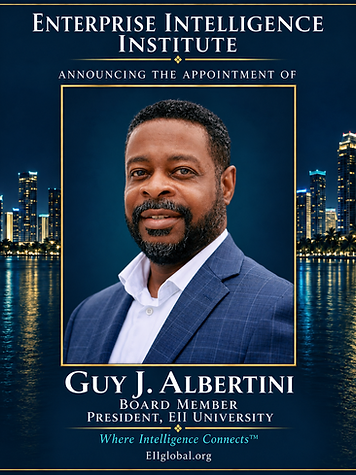
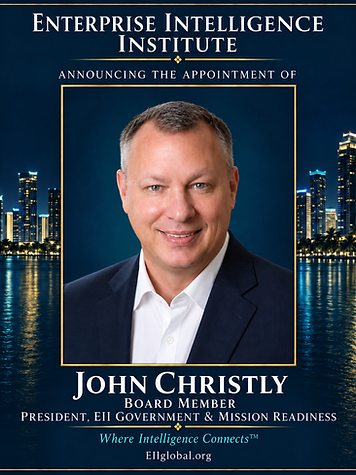
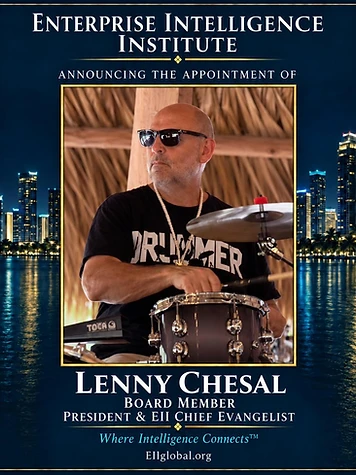
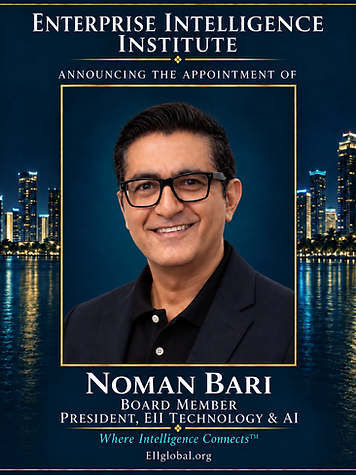
The Institute's founding directors were appointed at the Founding Assembly, September 2026. Each holds fiduciary responsibility for the Institute's mission, standards independence, and governance.








Conduct Standard
- Directors owe the Institute duties of care, loyalty, and obedience — standard nonprofit fiduciary duties consistent with the Institute's state of incorporation and applicable nonprofit law.
- Directors must disclose, in writing, any financial or professional relationship with dōlogiic, the CCF Institute, FMU, or any organization seeking to influence Institute standards or funding decisions.
- A director with a disclosed conflict on a specific matter must recuse from discussion and voting on that matter, consistent with the Conflict-of-Interest Policy.
Standards Independence Safeguard
The Institute's core credibility commitment — close to non-negotiable in any redline.
- No individual or organization may purchase influence over CCF-BOK content, working group findings, or research conclusions through membership dues, sponsorship, or donation, at any level.
- Corporate Charter Members do not receive working group seats by virtue of dues — participation is based on expertise and contribution.
- Research findings under the Research Agenda are published even when they do not favor a commercial implementation of the methodology, including dōlogiic's.
- Any deviation from this safeguard requires disclosed Board approval and public disclosure of the arrangement — it should never happen silently.
Decision-Making and Documentation
- Board resolutions, Council decisions, and working group publications are documented in a decision register maintained by the Institute Secretary.
- Standards and CCF-BOK content proceed through Founding Council review before publication.
- Minutes of Board and Council meetings are retained per the document retention schedule counsel recommends.
Current directors
Guy Albertini
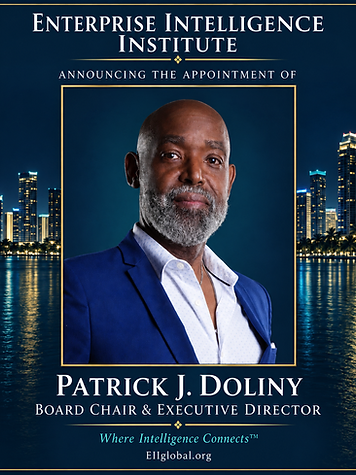
Patrick Doliny
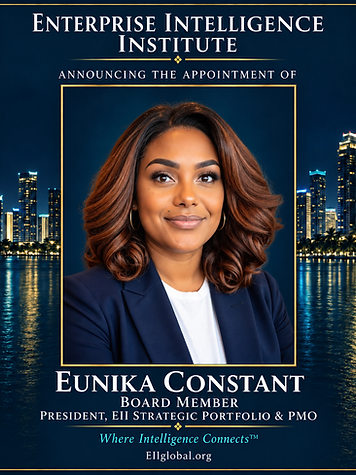
Eunika Constant
John Christly
Noman Bari
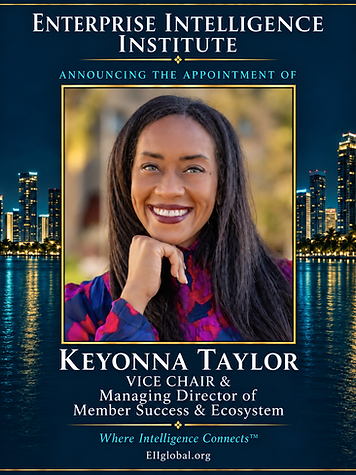
Keyonna Taylor


Lenard (Lenny) Chesal
Additional directors will be announced as the board expands. The Institute's founding directors are shown above; further appointments proceed through the Governance and Nominating Committee.
Advisory leadership for a forming profession
The Founding Council advises on and shapes the direction of the profession and its standards during the founding period. Unlike the Board of Directors, the Founding Council is not a fiduciary body — its authority is advisory and directional, grounded in professional standing and contribution.
Role
- Advises on the direction of the profession and standards
- Reviews standards and CCF-BOK content before publication
- Shapes the Founding Declaration and companion documents
Distinction from the Board
- Not a fiduciary body — no legal authority over the entity
- Authority is professional and advisory, not legal
- Governed by IEI-004 Founding Council Charter
Current council members
Founding Council members will be announced following the Founding Assembly on September 18, 2026. Council composition is being finalized as part of the founding process.
Learn about the Founding AssemblyBy invitation only
Founding Fellow designation (IEI-005) recognizes foundational contribution to the establishment of the discipline. Fellows contribute expertise and work product to standards, research, and education. The designation is never purchasable and cannot be self-assigned.
Contribution
Recognizes foundational work product — standards, research, or education — that helped establish the discipline.
Integrity
Fellows represent their credentials truthfully and do not overstate the validation status of any Institute construct.
Invitation
Conferred by invitation only, governed by the IEI-005 Founding Fellow Standard. Cannot be purchased through dues or sponsorship.
The Founding Fellows Registry will be published following the Founding Assembly.
Current Founding Fellows
Executive and operational leadership
The Institute's executive leadership directs the day-to-day operations of the profession — research, standards, education, membership, and community — under the authority of the Board of Directors.
Keyonna Taylor
Patrick Doliny
A profession grounded in ethics
The Governance and Ethics Framework (IEI-003) operationalizes the Institute's founding principles into conduct standards, a code of ethics, and conflict-of-interest safeguards. Membership requires acknowledgment of the Code of Ethics.
The Institute's conflict-of-interest policy and code of ethics have been adopted as part of its 501(c)(3) governance framework, consistent with IRS Form 1023 requirements and applicable state nonprofit law. The summary below is a public-facing overview; the full governing documents are maintained on file.
Governing Principles
Independence
The Institute's standards and research will not be for sale to sponsors, members, or partners.
Evidence
No construct is presented as validated until it has been.
Distinction
The Institute, the Clinical Cybersecurity Framework, dōlogiic, and academic partners remain separate and clearly bounded entities.
Code of Ethics
Drawn from the Institute's founding principles and adopted as part of its governance framework.
- Practitioners and Fellows represent their credentials, contributions, and certifications truthfully and do not overstate the validation status of any Institute construct.
- No Institute representative discloses confidential pilot-organization data without that organization's explicit written consent.
- Research findings are reported honestly, including null or unfavorable results, consistent with the Research Agenda's Reliability & Validity and Outcome Correlation phases.
- Members and Fellows do not use Institute affiliation to imply endorsement of a specific commercial product beyond what has been formally and transparently agreed.
- Complaints of ethical violations may be submitted to the Institute Secretary and are reviewed under a defined complaint and review process.
Conflict-of-Interest Policy
The Institute's adopted conflict-of-interest policy conforms to the sample language in the IRS Form 1023 instructions, adapted to the Institute's specific relationships.
| Element | Draft Content |
|---|---|
| Definition of 'interested person' | Any director, officer, Founding Council member, or key employee with a direct or indirect financial interest in a matter before the Institute. |
| Duty to disclose | Interested persons must disclose the existence and nature of a financial interest before the Board or Council takes action on a related matter. |
| Recusal procedure | The interested person may participate in discussion for information purposes only, then must leave the room for deliberation and voting. |
| Annual disclosure statement | Every director, officer, and Founding Council member signs an annual disclosure form. |
| Violations procedure | Suspected violations are reviewed by the Board (excluding the person in question), with findings and any corrective action documented in the minutes. |
Complaint & Review Process
Being finalized — a defined process for receiving, reviewing, and resolving ethics or conflict-of-interest complaints, including who is recused from reviewing a complaint about themselves, documentation retained, and the range of outcomes available to the Board (from no action to removal).
Related-Party Transaction Policy
Being finalized, with particular attention to any commercial agreement between the Institute and dōlogiic or the CCF Institute — licensing fees, data-sharing arrangements, or in-kind contributions should all be reviewed under this policy before execution.
Institutional relationships and boundaries
EII distinguishes partners from sponsors. Each relationship requires administrative approval and is governed by clear boundaries that protect the Institute's independence and the integrity of its standards.
Commercial Affiliates
dōlogiic and other commercial entities that operationalize the methodology. The Institute does not endorse commercial products as a condition of standards participation, and commercial affiliates do not receive standards influence by virtue of the relationship.
Framework Stewards
The Clinical Cybersecurity Framework (CCF) and its intellectual property remain the property of their existing owner(s) unless and until a separate, counsel-reviewed licensing agreement transfers or licenses specific rights to the Institute.
Academic Partners
FMU and other academic institutions relate to the Institute through separate partnership agreements, not through governance authority over the Institute itself. Academic partnerships advance research, education, and evidence-building.
Independence Guardrails
- The Institute is an independent entity — it does not own, and is not owned by, any commercial or framework steward organization.
- Sponsorship does not purchase standards influence, credentials, Fellow designation, or governance authority.
- All affiliate relationships are reviewed under the Related-Party Transaction Policy before execution.
Approved partners will be displayed once relationships are confirmed and counsel-reviewed agreements are in place. The Institute does not publish partner relationships prior to formal execution.
Reach the Institute
Different inquiries route to different teams — membership, institutional, research, sponsorship, media, chapter formation and more. Use the relevant form for the fastest response.
Frequently Asked Questions
Common questions about the Enterprise Intelligence Institute, the discipline it stewards, and how its standards, frameworks, and certifications fit together.